


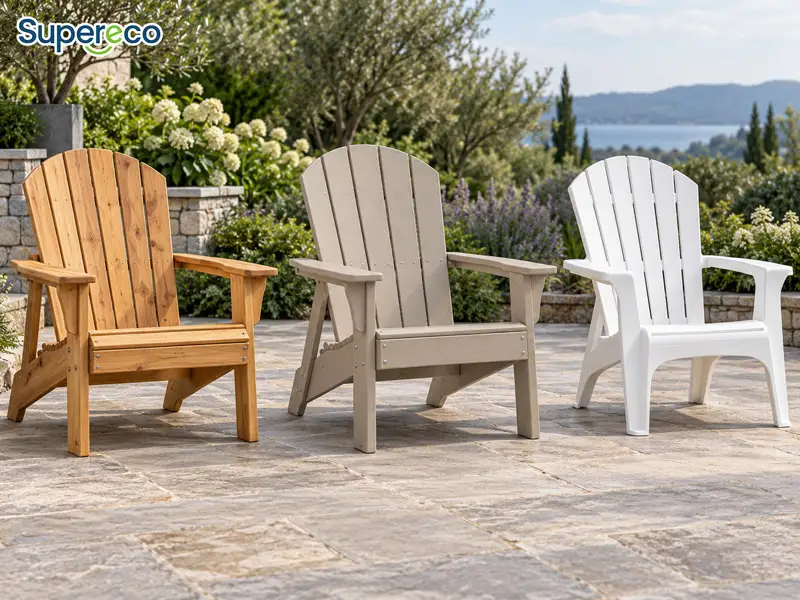
Adirondack chairs are commonly made from solid wood, high-density polyethylene (HDPE), and other plastics. Some designs use wood-plastic composites or metal. The material influences appearance, maintenance and manufacturing methods, while the finished chair’s comfort and stability also depend on its construction and hardware.
Product descriptions often use terms such as plastic, resin and poly lumber. Understanding how these terms relate to HDPE makes it easier to compare products and prepare accurate purchasing specifications.
For wholesalers, retailers and hospitality buyers, the key is to connect material selection with the finished product: how it is built, how it will be maintained, and how consistently it can be supplied.
What Materials Are Commonly Used for Adirondack Chairs?
Solid wood, HDPE and other plastics are common Adirondack chair materials. Wood offers natural grain and texture, while HDPE provides multiple colors and finishes with routine care focused mainly on cleaning.
| Material | Common Construction | Main Characteristics | What to Compare |
|---|---|---|---|
| Solid wood | Machined and assembled boards made from teak, cedar, pine, acacia or other species | Natural grain and texture; maintenance varies by species and finish | Wood species, surface treatment and maintenance schedule |
| HDPE | Machined and assembled high-density polyethylene boards or profiles | Low water absorption, multiple colors and finishes, and typically no recurring painting requirements | Board dimensions, support structure, hardware and functions |
| Other plastics | Materials such as PP or PS, used in molded or assembled designs | Weight, feel and performance vary by material and design | Specific resin, manufacturing method and finished specifications |
| Wood-plastic composite | Wood fibers or flour combined with plastic | Appearance and processing characteristics depend on the composite formulation | Composition, construction and maintenance requirements |
| Metal | Aluminum or steel, sometimes combined with other seating materials | Available in different styles and structural designs | Metal type, surface treatment and connections |
Start with the intended application. A retail collection may prioritize appearance, assembly and packaging. A hotel project may place greater emphasis on cleaning, guest comfort, maintenance and replacement parts.
For a detailed comparison of the two principal options covered here, see HDPE vs. wood Adirondack chairs.
What Is the Difference Between HDPE, Plastic, Resin and Poly Lumber?
HDPE identifies a specific plastic, Plastic is a broad material category, Resin is a general term, and Poly Lumber usually describes plastic boards or profiles with a lumber-like form. These names communicate different types of information.
| Term | What It Describes | What Buyers Should Confirm |
|---|---|---|
| HDPE | High-density polyethylene, a specific thermoplastic | Material requirements and the relevant product configuration |
| Plastic | A broad category that includes HDPE, PP, PS and other polymers | The specific resin used |
| Resin | A general material term often used in furniture descriptions | The actual polymer and product construction |
| Poly lumber | Plastic boards or profiles used in a lumber-like format | Resin type, cross-sectional dimensions and surface finish |
A chair assembled from HDPE boards can be described as an HDPE Adirondack chair, a plastic Adirondack chair and a poly lumber Adirondack chair.
Is Resin Different from HDPE?
“Resin” alone does not identify a separate Adirondack chair material. HDPE is one type of resin, so the useful comparison is between specified polymers and finished constructions.
For example, an HDPE board-assembled chair and a molded PP chair should be compared through their actual dimensions, structure, hardware, performance requirements and maintenance instructions.
Is Poly Lumber the Same as HDPE?
Poly lumber describes the material’s board-like form; HDPE describes its polymer composition. HDPE is used to manufacture poly lumber for outdoor furniture.
For purchasing documents, specify both where applicable: HDPE poly lumber Adirondack chair, followed by the model, dimensions, finish, hardware and packaging requirements.
How Are HDPE Adirondack Chairs Made?
Board-assembled HDPE Adirondack chairs are made by producing HDPE boards or profiles, machining them into components, finishing contact surfaces, and assembling them with hardware.
Each stage contributes to the finished chair’s consistency and usability.
Board and Profile Production
The material is formed into the cross-sections required for the design. Formulation, processing and dimensional control help establish consistent components for subsequent machining.
Cross-sectional dimensions matter because boards serve different functions. A backrest slat, armrest and structural support should each be evaluated according to their role in the chair.
Component Machining
Boards are cut and shaped into seat slats, backrest slats, armrests, legs and supports. Hole positions and component dimensions must work together so the chair can be assembled correctly.
Accurate machining supports repeatable assembly, which is especially important when supplying multiple units to retailers or commercial projects.
Surface and Edge Finishing
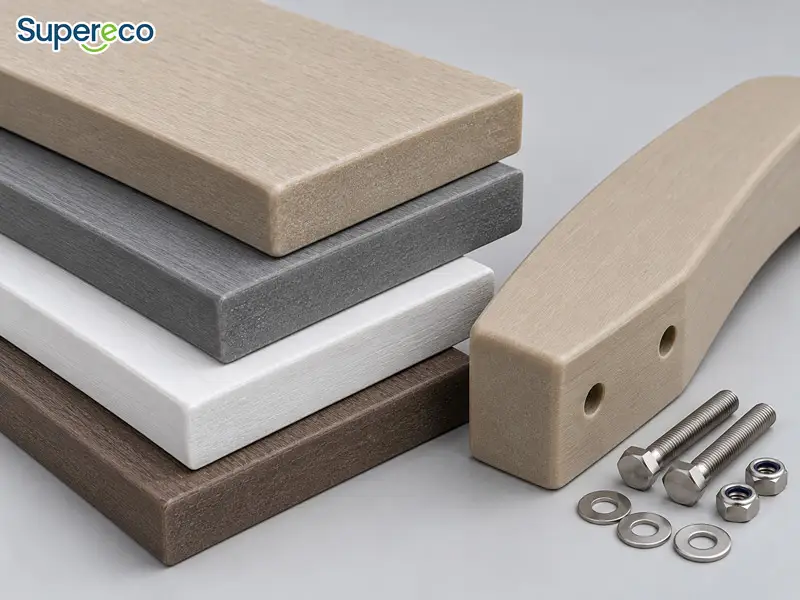
Smooth, brushed and wood-grain finishes provide different visual and tactile effects. Edge finishing is equally important at the armrests, seat front and other areas that contact the user.
Approve both a finish sample and a complete chair. A small sample shows color and texture; an assembled chair shows how the finish works across the product.
Assembly and Inspection
Components are connected using the specified hardware, followed by checks for dimensions, appearance, fit and operation.
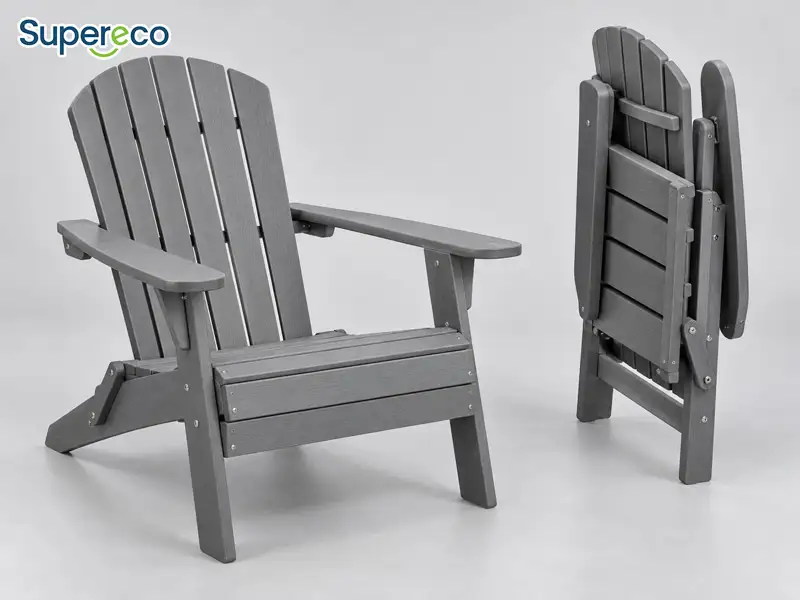
Functional checks should match the model. Folding chairs require folding and opening checks; rocking chairs require checks of the rocking structure and clearances.
Supereco’s HDPE Adirondack chairs include classic, folding, rocking and ottoman styles, allowing buyers to select different functions within a coordinated collection.
Why Is HDPE Used for Outdoor Adirondack Chairs?
HDPE offers low water absorption, straightforward cleaning and typically no requirement for recurring staining or painting. Outdoor formulations, structural design and suitable hardware help adapt these characteristics to the intended environment.
Low Water Absorption Supports Wet-Weather Use
HDPE does not rot like wood and does not require the same preservative finishing approach. This helps simplify care in locations exposed to rain and humidity.
Chair design still matters. Slat spacing, drainage and access around connections affect how easily water and dirt can be removed during routine cleaning.
Less Recurring Surface Refinishing
HDPE chairs typically do not require periodic sanding, staining or repainting. For hotels and resorts managing multiple chairs, this can reduce refinishing work and the associated time out of service.
Routine care should include cleaning, checking fasteners and maintaining moving parts according to the product instructions.
UV Stabilization Supports Weathering Performance
UV stabilizers help limit degradation caused by ultraviolet exposure. Buyers should relate weathering requirements to the actual formulation, color, test method and exposure conditions.
When reviewing a test report, check what was assessed—for example, color change, surface condition or retained mechanical properties. A stated number of test hours should be interpreted with its method and acceptance criteria, rather than treated as a direct service-life prediction.
Colors and Finishes Support Coordinated Collections
HDPE can be produced in different colors and surface textures, helping retailers coordinate styles and commercial buyers match furniture across a property.
For repeat orders, retain approved color samples and configuration records. These provide a clear reference when discussing production and replenishment.
What Does a Supereco Folding Adirondack Chair Specification Look Like?
One representative Supereco folding Adirondack chair combines UV-stabilized HDPE, 304 stainless steel hardware and approximately 70% pre-assembly. Its specifications show how material, construction and delivery information form a complete purchasing reference.
| Item | Representative Model Specification | Why It Matters |
|---|---|---|
| Main material | UV-stabilized HDPE | Defines the material configuration |
| Overall dimensions (L × W × H) | 84.5 × 68.4 × 98 cm | Supports layout and display planning |
| Seat dimensions (W × D × H) | 52 × 53 × 37 cm | Supports seating assessment |
| Hardware | 304 stainless steel | Defines the connection hardware |
| Finish options | Brushed / wood grain | Establishes the surface appearance |
| Pre-assembly | Approximately 70% | Helps plan final installation |
| Export packing | 1 chair per carton | Supports receiving and inventory planning |
| Carton dimensions | 93 × 53 × 16 cm | Supports freight and storage estimates |
| Gross weight per carton | 17.5 kg | Supports handling and logistics planning |
| Carton volume | Approximately 0.079 m³ | Supports preliminary freight calculations |
| Reference 40HQ loading | Approximately 886 chairs | Supports full-container planning |
These figures apply to the representative model. Other styles and custom configurations are confirmed for each order, and final loading quantities depend on packaging, pallet requirements and the product mix.
The carton measurement is the export package size. The assembled chair’s folded dimensions should be confirmed separately.
Explore Folding HDPE Adirondack Chairs for further product and configuration details.
How Does Supereco Support Bulk Adirondack Chair Sourcing?
Supereco combines manufacturing, product development, quality control and export coordination to support standard-product and OEM/ODM orders for wholesalers, distributors, retailers and commercial projects.
Our manufacturing facility in Linyi, China, operates more than 120 production lines. Buyers can select existing designs and confirm colors, finishes, features, branding and packaging through samples and specifications.
Quality control covers incoming materials, production, finished products and export packaging. Our in-house laboratory supports applicable testing for structural strength, load performance, dimensions, materials and UV resistance. Independent third-party testing is also conducted through organizations such as SGS and Intertek. Relevant documentation can be reviewed against the selected model and market requirements.
Since expanding internationally in 2008, Supereco has supplied buyers in more than 70 countries and regions. We coordinate product specifications, packaging and shipment requirements to support bulk delivery and repeat purchasing.
To discuss an order, send your target styles or reference images, quantity per model, destination, customization requirements and target delivery date. These details help us confirm suitable options, sample arrangements and pricing.
FAQ About Adirondack Chair
What Is the Best Material for Adirondack Chairs Used Outdoors?
HDPE is a practical choice when low maintenance, moisture resistance and coordinated colors are priorities. Solid wood suits buyers who prefer natural grain and can accommodate the maintenance required by the selected species and finish.
For commercial projects, compare the complete chair as well as the material, including its support structure, hardware, comfort and applicable test documentation.
How Long Do HDPE Adirondack Chairs Last?
HDPE Adirondack chairs are designed for long-term outdoor use. Their service life depends on the material formulation, construction, hardware, exposure conditions and care.
For bulk purchasing, review the selected model’s weathering and structural test information alongside its warranty terms. Confirm whether the warranty covers residential or commercial use rather than relying on a general lifespan claim.
Why Do Adirondack Chair Prices Vary So Much?
Price differences reflect the material, component dimensions, construction, hardware, machining, finish and packaging. Order quantity and customization also affect the quotation.
Compare suppliers against the same specification, then include freight, final assembly and maintenance in the cost assessment. This gives a more useful comparison than unit price alone.
Can I Approve a Sample Before Ordering in Bulk?
Yes. Supereco can provide samples for evaluation before bulk production. Use the sample to confirm dimensions, comfort, finish, hardware, assembly and any folding or rocking functions.
Record the approved configuration in a specification sheet and retain the sample as a production reference. Sample costs, shipping and timing can be confirmed for the selected model.
Can Supereco Customize Adirondack Chairs for Private-Label Orders?
Yes. Supereco supports OEM/ODM requirements covering colors, surface textures, selected features, branding and packaging.
Send your reference design, target market, quantity and customization requirements. We can then review feasibility and confirm the specifications, sample arrangements and quotation.
What Information Is Needed for a Wholesale Adirondack Chair Quote?
Provide the chair style or reference image, quantity per model, destination, preferred colors and any branding or packaging requirements. Include your target delivery date and applicable testing requirements.
These details help us confirm the configuration, production schedule and shipping information. You can also request carton dimensions, gross weight and a loading plan to assess the delivered cost.